

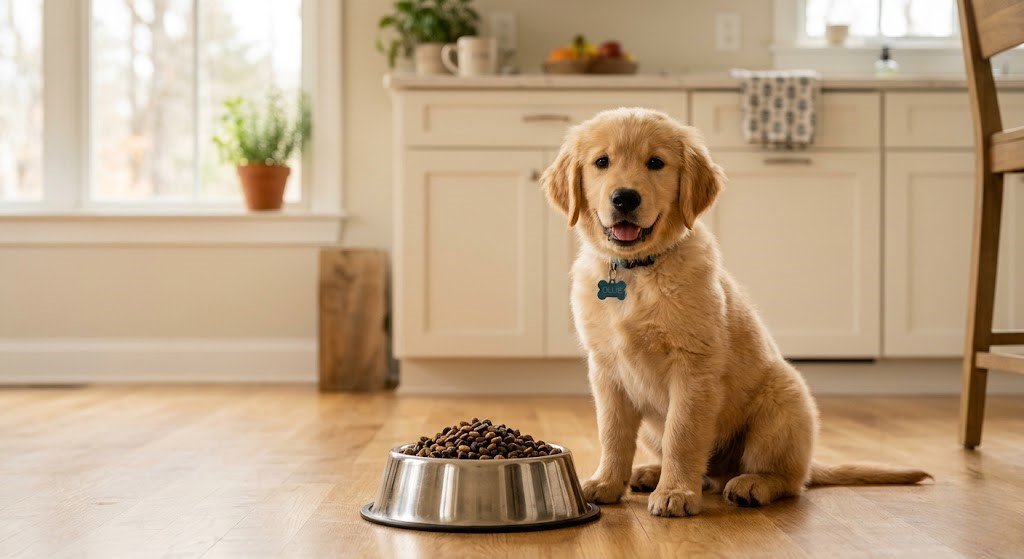
Nourishing a growing puppy requires precision. Overfeeding puts excessive stress on developing joints, while underfeeding robs them of essential nutrients needed for vital organ development. Understanding exact feeding portions based on age, weight, and breed size is essential for ensuring your puppy hits every milestone safely.
This guide provides a comprehensive growth and feeding chart, step-by-step instructions for calculating daily caloric needs, and actionable advice to structure an ideal puppy feeding schedule.
Key Takeaways
- Caloric Needs Peak Early: Puppies under 4 months require nearly 2 to 3 times the daily calories per pound of an adult dog.
- Weight & Breed Matter: Large and giant breeds need specialized, lower-calorie formulas to prevent overly rapid growth and bone issues.
- Taper Frequency Over Time: Start with 4 meals per day at 8 weeks, gradually tapering down to 2 meals daily by 6 to 12 months.
- Body Condition Over Numbers: Use physical indicators—such as a visible waist and palpable ribs—to adjust daily portions rather than relying solely on chart averages.
Puppy Feeding Chart by Weight & Age
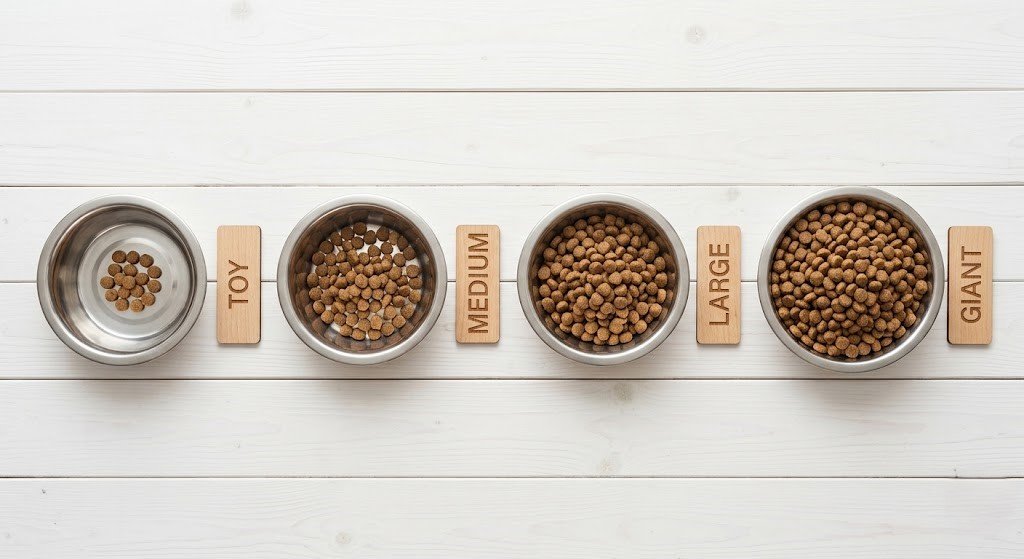
To determine how much to feed a puppy, refer to the estimated mature adult weight alongside current age brackets. The following reference chart outlines daily food intake in standard measuring cups (assuming standard commercial dry puppy kibble with roughly 350–400 kcal per cup).
| Estimated Adult Weight | 8 to 12 Weeks (Daily) | 3 to 6 Months (Daily) | 6 to 12 Months (Daily) | 12 to 24 Months (Daily) |
| Toy / Small (< 12 lbs) | ½ to 1 cup | ⅔ to 1⅓ cups | ½ to 1 cup | Adult Formula |
| Medium (13 to 50 lbs) | 1 to 2 cups | 1½ to 2¾ cups | 1½ to 2½ cups | Adult Formula |
| Large (51 to 90 lbs) | 2 to 3 cups | 3 to 4½ cups | 3½ to 5 cups | 3 to 4½ cups |
| Giant (90+ lbs) | 2½ to 4 cups | 4 to 6 cups | 5 to 7½ cups | 5 to 7 cups |
Note: Always cross-check generic figures with the calorie density printed on your specific feed bag, as caloric density can vary significantly across brands.
How to Calculate Your Puppy’s Exact Daily Caloric Needs
While feeding charts provide an excellent baseline, calculating exact energy requirements offers greater accuracy. Veterinarians compute a puppy’s energy intake based on their Resting Energy Requirement (RER).
The Veterinary RER Formula
- Convert your puppy’s current weight from pounds to kilograms ($1\text{ kg} = 2.2\text{ lbs}$).
- Calculate the RER: $\text{RER (kcal/day)} = 70 \times (\text{body weight in kg})^{0.75}$.
- Apply the Growth Multiplier:
- Weaning to 4 Months Old: $\text{Daily Calories} = \text{RER} \times 3.0$
- 4 Months to Full Growth: $\text{Daily Calories} = \text{RER} \times 2.0$
Divide your calculated total daily calories by the “kcal per cup” listed on the back of your dog food packaging to find the precise daily portion.
Puppy Feeding Schedule by Age
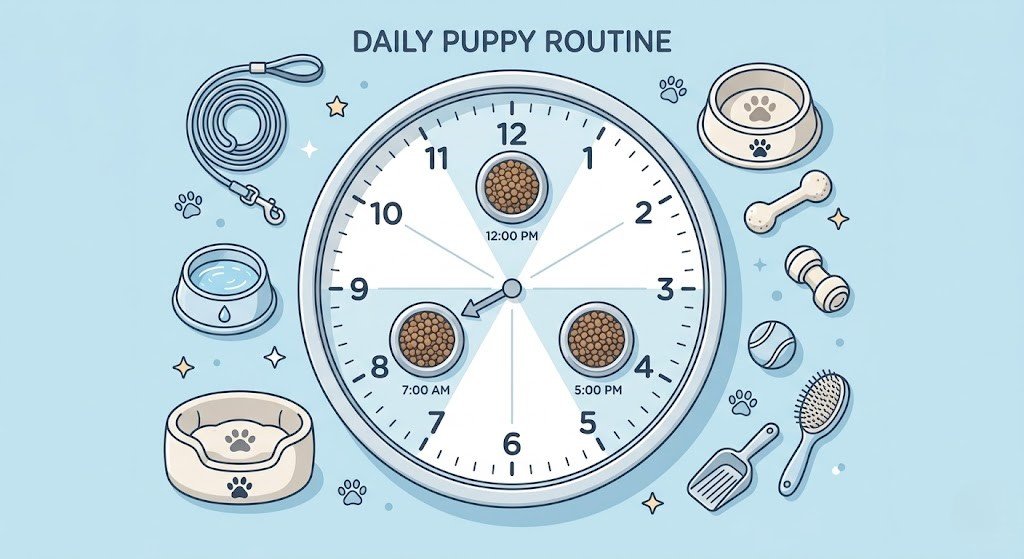
Meal frequency is critical for maintaining stable blood sugar levels and ensuring proper digestion. Young puppies have small stomach capacities and high metabolic demands.
- 6 to 12 Weeks: 4 meals per day spaced evenly (e.g., 7 AM, 11 AM, 3 PM, 7 PM). Toy breeds especially benefit from frequent meals to prevent hypoglycemia.
- 3 to 6 Months: 3 meals per day (e.g., 7 AM, 1 PM, 7 PM).
- 6 to 12 Months (up to 24 months for giant breeds): 2 meals per day (morning and evening).
Evaluating Body Condition Score (BCS)
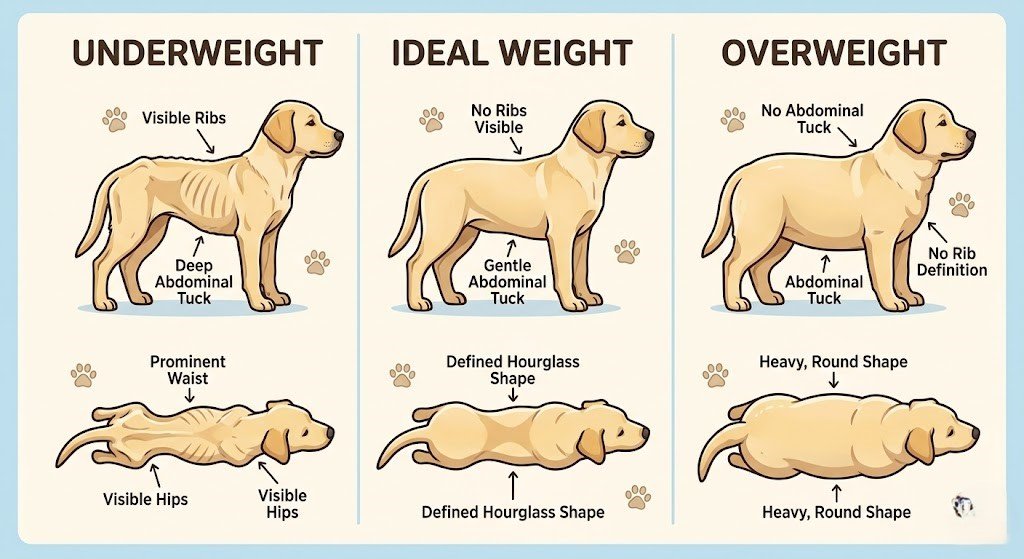
When asking how much to feed a puppy, physical condition provides the best guidance. Scale weight alone can be deceptive during rapid growth phases.
       UNDERWEIGHT                   IDEAL                      OVERWEIGHT
   [ Ribs/Spine Visible ]     [ Easily Felt Ribs ]       [ Hidden Ribs under Fat ]
   [ Severe Waist Tuck ]      [ Visible Waistline ]      [ No Waist / Round Body ]
- Ideal Weight: You should easily feel the ribs under a thin layer of fat without pressing hard. Viewed from above, an hourglass waist should be visible behind the ribcage.
- Underweight: Ribs, hip bones, or vertebrae are clearly protruding. Increase total daily intake by 10%.
- Overweight: No waistline is visible from above, and a layer of fat covers the ribs. Reduce total daily intake by 10% and reassess in two weeks.
For official standards on canine clinical nutrition and body scoring metrics, consult the [External Link: Insert high-authority external URL here with anchor text: World Small Animal Veterinary Association (WSAVA) Nutritional Assessment Guidelines].
Transitioning to Adult Food
Transitioning to adult food too early can deprive a growing puppy of necessary nutrients, while transitioning too late can lead to weight gain.
- Small Breeds (< 20 lbs): Switch at 9 to 12 months.
- Medium Breeds (20–50 lbs): Switch at 12 to 14 months.
- Large & Giant Breeds (50+ lbs): Switch at 18 to 24 months.
The 7-Day Transition Method
Shift foods slowly over 7 days to avoid stomach upset:
- Days 1–2: 75% puppy food, 25% adult food
- Days 3–4: 50% puppy food, 50% adult food
- Days 5–6: 25% puppy food, 75% adult food
- Day 7: 100% adult food
Frequently Asked Questions
What should I do if my puppy is always hungry?
Puppies naturally seek out food due to high energy demands. First, confirm you are meeting their caloric requirements using an RER formula. If body condition scores are ideal, avoid increasing food portions; instead, use slow-feed bowls or puzzle toys to extend meal times.
Can I free-feed my puppy by leaving food out all day?
Free-feeding is not recommended. Scheduled feedings help establish predictable potty habits, allow you to monitor appetite changes, and prevent overeating.
How do training treats affect daily puppy feeding portions?
Treats should make up no more than 10% of a puppy’s total daily caloric intake. When training frequently, subtract the calories provided by treats from their primary daily meal allowance.
Final Thoughts
Determining how much to feed a puppy requires adjusting portions based on age, weight, and body condition. Utilizing a feeding chart as a starting point, recalculating caloric intake regularly, and monitoring physical condition ensures steady, healthy growth. Consult a veterinarian to customize a plan tailored to your puppy’s specific breed and medical needs.